Saturday, 9 April 2011

Andro Wekua, Pink Wave Hunter


Andro Wekua, Pink Wave Hunter, 2011
Installation view with Pink Wave Hunter Series, 2010/2011 and Sunset Painting, 2005/2011. Courtesy: the artist and Gladstone Gallery, New York/Brussels. Photo: Nils Klinger

Sunday, 27 February 2011

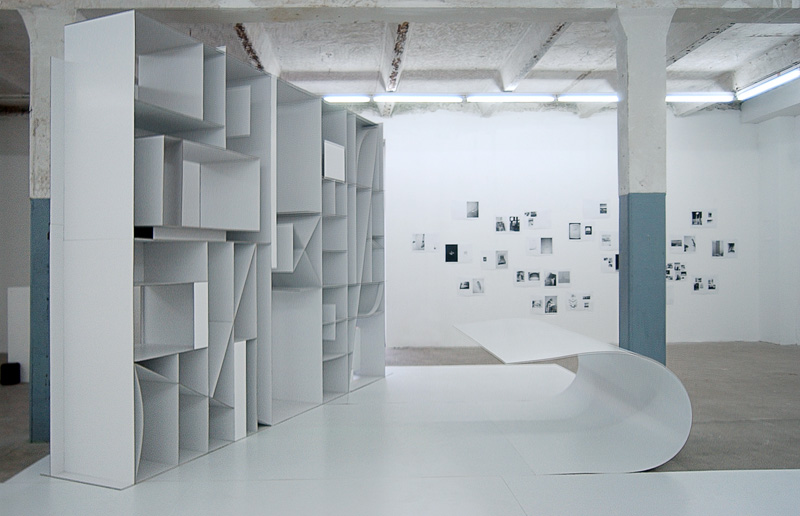
Tilman Wendland + Hansen / Le Corbusier / Niemeyer


Untitled, 2006
Cardboard, masonite, magazine copy,
varible dimensions
Courtesy of the artist & European Art Projects
Photos: Krzysztof Zieliński / European Art Projects

Tilman Wendland (*1969, lives in Berlin) creates from basic, light materials such as paper, cardboard and PVC ephemeral structures, which are integrated in existent architectural situations. They provide comments, criticisms or also caricatures. Normally, his works, which are seldom intended to last, are rendered completely in white. In spite of the strict reduction of colour and form they reveal themselves through a playful-ironic treatment of the subject.
For Ideal City - Invisible Cities Wendland developed a room installation, which enquired into the architectural and city planning shapes and elements of Le Corbusier, Oskar Hansen and Oscar Niemeyer. The ideal city concepts of the architects were condensed by Wendland into space-penetrating white cardboard shelves, sublime and also perishable


Valeska Soares + Niemeyer

Tonight, 2002

Titled Tonight (2002), the video was first installed in the very dance hall where the sequences had been filmed. The soundtrack is a remixed version of Burt Bacharach’s song The Look of Love (1967), altered by Belo Horizonte sound artists O Grivo. A first version of Folly has been shown at the 51st Venice Biennial in 2005.

Anthony Auerbach + Johnson

The State of New York, aerial survey, New York State Pavilion, Flushing Meadows Corona Park, Queens, New York, 11–13 October 2006, 2,427 vertical photographs

Saturday, 26 February 2011

Lucy Williams + Mies van der Rohe

The Glass-Walled House in Summer 2005 mixed media, 28-1/2 x 28-1/2 x 1-1/2 inches Courtesy McKee Gallery

Jim Isermann + Le Corbusier


Project Unité Firminy
1993
papier peint sérigraphié, linoléum coupé, coussins de mousse
dimensions variables

 via Jim Isermann

Natasha Kissell + Mies van der Rohe


Pink Canyons, 2008, 48" x 42", oil on canvas

Angelina Gualdoni + Costa / Niemeyer

Praca dos Tres Poderes, Noon
Oil and Acrylic on Canvas
48" x 84"
2005


via Angelina Gualdoni

Christine Erhard + Lubetkin

Penguin Pool, 200670 x 90 cm

via Christine Erhard

AKassen + Mansilla / Tuñón


Window to the world
Window glass from the facade of the museum is installed in three sets of joined automatic slidingdoors. The piece functions as a kinetic sculpture activated by the movements of the audience and itself.

via AKassen

Christian Anderson + Mies van der Rohe

Installation view: Christian Andersson, From Lucy with love, Moderna Museet Malmö, 22 January-24 April, 2011. Photo: Terje Östling © Christian Andersson/BUS 2011. All works courtesy the artist and Galerie Nordenhake, Berlin/Stockholm.

http://www.christianandersson.net/shows/from-lucy-with-love

Tuesday, 22 February 2011

Fiona Tan + SANAA

 
Cloud Island I, Project for the Venice Architecture Biennale, 2010
2 channel HD installation
colour, stereo
2 HD-cam safety masters, 2 HD projectors, 2 harddisc players, 2 stereo amplifiers, 4 stereo speakers, 1 double-sided white projection screen 2.0 x 1.12 m

Filmed on location on Inujima and Teshima, Japan

Commissioned by the Naoshima Fukutake Art Museum Foundation
Funded by Naoshima Fukutake Art Museum Foundation and Wako Works of Art, Tokyo

via Fiona Tan

John Riddy + Soane

London (Bank) 2008, 2009
Photograph on paper
image: 720 x 930 mm
on paper, print

Ed Ruscha + Armet & Davis


Norm's, La Cienega, on Fire, 1964, oil on canvas 64 1/4 H x 124 1/2 W (inches)

Ed Ruscha + Pereira


Los Angeles County Museum on Fire, 1968, oil on canvas 53 1/2 H x 133 1/2 W (inches)

Monday, 21 February 2011

Pierre Bismuth + Le Corbusier

Complexe des villas / Bâtiment Le Corbusier (élévation)
2010
Ink on polyacetate
28.35 x 20.47 inches
Pièce unique
Pierre BISMUTH performs the impossible synthesis between the two faces of Le Corbusier: from the villas blanches to housing projects, with a sense of humor and economy of means that are his trademark. He superposes, in a small scale model, section views and computer generated images (Complexes des villas / Bâtiment Le Corbusier, 2006-2010), several Villas Savoye, to create a building that the Swiss architect might not have rejected – let alone the destiny of neglected social housing and the carcass of torched cars in front.

George Maciunas + Le Corbusier


http://fluxusfoundation.com/fluxus-as-architecture/george-maciunas-and-le-corbusier/

Xing Danwen + Holl


Urban Fiction
2004 - present

photography with digital manipulation


My interest for urban subject has been complated in my mind for years but the particular idea of this work was forged some time in 2004 while I traveled extensively in Europe. After being in so many cities in the world, I realized that globalization has made urban landscapes everywhere similar and blurred the boundaries between them. So often, "here" can be anywhere. With this work, I have brought my vision and perspective to these urban spaces.

The architectural structures that I photographed are all maquettes made to promote real-estate developments that are being planned in China today. Some of the buildings already exist, and others will soon begin construction. When you face these models showing such a variety of different spaces and think about the life-styles associated with them, you start to wonder: is this the picture of life today? Do we really live in this kind of space and environment?

Globalization is reshaping our urban environment and our vision of contemporary life - which celebrates the “new” constantly replacing the “old.” As personal living spaces expand with the growth of income, the cityscape becomes more dense, filled up with modern buildings and high-rise towers. People live in cubes that are squeezed next to one another, separated only by thin walls. This physical proximity, instead of leading to greater closeness and intimacy between people, can often create psychological distance and loneliness.

The sculptural form of these new residential buildings, the floor plan of the apartments, and the various interior designs are all related to the inhabitants and their “individual” taste and needs. The models of these new living spaces are perfect, clean and beautiful but they are also so empty and detached of human drama. When you take these models and begin to add real life - even a single drop of it - so much changes.

This entire body of work of "Urban Fiction" is playful and fictitious - wandering between reality and fantasy. All the figures in this series are acts of me, playing different characters. This creates another paradox: “I” am real but at the same time “I” am unreal. The figures act out totally imaginative roles and fanciful stories, staged within the maquettes, their plots invented by me and visualized for these spaces. For example, “I” am a white-collar office worker brought to despair by job pressures and spiritual emptiness. Sometimes “I” am a materialistic woman enjoying a life of pleasure and dissipation. Or “I” am a young girl who, in a moment of unrestrained rage, accidentally killed her lover. Together, the resulting pictures compose an episodes, serialized narrative structure for "Urban Fiction". As a whole, these images represent the state of urban life today.

In the period of my childhood in China, skyscrapers were unattainable concepts connected to the West, viewable only in films or magazines. Today I live in the pictures I make and I, along with my compatriots, can imagine our future by bending down to examine tiny models of buildings. This, perhaps, is another reality of the "fantasies" which govern our contemporary life.

The photographs are shot both digitally and on film and manipulated, creating many layers, utilizing computer program tools.

The medium is photographic C - print.
Large size: DIASEC (back-mounting on dibond, face-mounting with Plexi-glas, rectangle brace behind)
Small size: back-mounting on dibond and with frame around.

There are 2 sizes:
Large size: the height is fixed at 170cm, the width varies from 210-270 cm; Edition of 5.
Small Size: the height is fixed at 80cm, the width varies from 100-150 cm; Edition of 8.


via Xing Danwen

Frederic Gmeiner, Torsten Posselt & Benjamin Maus + Libeskind


Jüdisches Museum, 2009
via Extracts of Local Distance