


Moshe Safdie Project (Detail), 2003
5 parts: cardboard, wood, expanding foam, cardboard, watercolour on tafetta, latex, wood and sponge, wood
Installation Dimensions Variable


Commissioned by Film and Video Umbrella and the Baltic Centre for Contemporary Art, and presented at Baltic in Gateshead in 2003 (taking up an entire floor of the gallery space), Jane and Louise Wilson’s ‘A Free and Anonymous Monument’ is arguably the largest and most ambitious video installation ever staged in the UK.
Continuing the Wilsons’ fascination with Modernist architecture and its legacy, the piece is explicitly grounded in the (post) industrial landscape of the North East of England (where the artists grew up) and whose complex, often chequered history of urban regeneration forms the subject of the work. Alive to the ways in which changing patterns of production have profoundly altered the local environment, the Wilsons are quick to temper some of the more seductive visions of contemporary economic renewal with salutary reminders of the region’s recent history; the automated assembly-lines, at hi-tech companies like Atmel on Tyneside, devoted to the manufacture of microscopic electronic components and computer chips, contrasted with the increasingly run-down remnants of earlier – and, in their own time, equally forward-looking – eras.
At the heart of the exhibition was another architectural landmark, Victor Pasmore’s Apollo Pavilion in the nearby ‘new town’ of Peterlee; a Utopian icon of post-war revival, now neglected and widely disdained by the local residents. A genuinely visionary architectural statement, the Pavilion leaves its mark on the project in many ways, not least in the installation configuration of the piece itself; its thirteen projection screens, and its multiform arrangement of planes and perspectives, echoing, and paying an affectionate homage to, its enduring experimental spirit.
The commission toured internationally following its presentation at Baltic in 2003 and formed part of the Visual Community Network involving five European venues and five exhibitions. Participating organisations were Baltic; BildMuseet, Umea, Sweden; Bergens Kunstmuseum, Bergen, Norway; Porin Taidemuseu, Pori, Finland and Nederlands Fotomuseum, Rotterdam, Holland.
Installation Photography: Baltic
http://www.fvu.co.uk/projects/details/a-free-and-anonymous-monument/


It’s looking like the 101-year-old Oscar Niemeyer won’t get the chance to put a final flourish to his career by adding a new project, Plaza of Sovereignty, to his masterwork, Brasilia. Yet if you want a reminder of the architect’s past brilliance, then it is worth looking at a collection of new work by Italian photographer Luisa Lambri. The photographs on show are a celebration of Niemeyer and the result of a trip the photographer undertook in 2003.
Casa das Canoas is Niemeyer’s own house built in 1953 in Rio De Janeiro, ‘Casa do Baile’, a dance hall in Belo Horizonte and built by the architect in 1942. Lambri’s work gives a new dimension to the operatic work of the modernist master, focusing on its details and interaction with the immediate surrounding area rather than focusing on the scale and the architecture. The photographer has well captured the aesthetic language developed by Niemeyer, a language saturated with distinctive geometry as well as organic curves.
A particular example is the collection of shots taken by Lambri at ‘Casa do Baile’: yes, the photographer is pointing her camera at Niemeyer’s work, but she is also reporting and investigating what is beyond. She is looking out to the landscape, subverting the point of view and giving context to the architect’s masterpieces. Also on display is an unusual shot taken at the Ministério da Educação e Saúde (Ministry of Education and Health), in which Lambri decided to frame a section of wall built in glass block, forming a rigid grid of lines, which seems melting when reflected in the black concrete floor.


Roosevelt Island is a small sliver of land situated between Manhattan and Queens, intersected by the Queensborough Bridge. Formally known as Welfare Island and originally home to New York's largest insane asylum, a small pox hospital, and a range of other 19th century municipal facilities for incarceration, it now houses one of the cities most visible, yet little-known modernist social housing projects. The subject of several architectural competitions during the 1960's that employed the island as a laboratory site, proposing a range of re-imagined futures, from a floating casino, to a Museum of Egyptian Artifacts, to a cemetery, to a Disney-like water and entertainment park, its current status is the result of the winning entry of Philip Johnson. Johnson's master plan proposed a mixed income, enclosed utopian community; a bucolic concrete enclave, divided into three residential developments.
Treating the medium of film as both a musical proposition and a proposal for collective production, A Necessary Music employs the resident of New York's Roosevelt Island as its authors and actors, gathering together texts written by them and using them to construct a script for the film. Casting seveteen residents to enact these lines accompanied by a fictional narration take from Adolfo Bioy Casares' 1941 science fiction novel 'The invention of Morel', the film deploys fiction as a tool to frame and activate its site. Self-consciously dissolving from attempted realism to imagined narrative, what begins as a process concerned with sociality becomes instead a ethnographic fiction about place and community, and an investigation into representation itself.
A Project by artist Beatrice Gibson, developed in collaboration with composer Alex Waterman. Narration by Robert Ashley.


Corviale is a 1 km long housing complex in the periphery of Rome. The building was commissioned in 1972 by the IACP (Institute for social housing) to a group of architects directed by Mario Fiorentino to solve the acute lack of housing for working class families. Furthermore like a barrier it should prevent the spreading of the city into nature. Finished in 1983, it is home to 9.500 tenants. The building was based on the idea of social housing according to Le Corbusier, to provide all needed infrastructures of a city within the complex itself, and to encourage social contacts between the occupants. For internal and political reasons many of these originally planned structures were never realized or are, almost 20 years after the first occupants moved in, still unfinished.
The occupants discuss missing infrastructures and prejudices from outside which characterize Corviale as a ghetto with high rates of unemployment, criminality and drug abuse.
The work addresses the failure of the utopian modernist architecture in social and everyday life.
Interviews with the occupants are juxtaposed with music-video like sequences featuring Roman Hip Hop which addresses social issues that are of concern in the film.
Script, Camera, Editing: Heidrun Holzfeind
Sound Operators: Songuel Boyraz, Giancarlo Norese, Valentina Palmieri, Simone Zaugg
Music: DJ Baro, Kaotici, Mone e Basta, Phella, Piotta, Sparo
EXHIBITIONS & SCREENINGS:
Prototipi, Fondazione Olivetti, Rome
Romadocfest, Rome
Corviale, Rome
Transmediale03 Berlin
Das reale berühren, Videofestival Kunstverein Munic
European Video Art, Videoart Center Tokyo
Image Festival, Tokyo
4D, Havana Biennale
Common Property/Allgemeingut, 6. Werkleitz Biennale, Halle, Germany
After Architects, Architekturmuseum Basel
Im[previsible]. Obras de Heidrun Holzfeind, Lado B, MUCA CU, Mexico City
The Building Show, Exit Art New York
Die Blaue Blume, Grazer Kunstverein
Rom Report, Badischer Kunstverein
Photocairo4, Cairo
kinolab, CCA, Warsaw


 In 2006 Jan De Cock presented “Denkmal 4, Casa del Fascio, Piazza del Popolo 4, Como,” a project in collaboration with Daniel Buren developed for three different locations: the Casa del Fascio in Como, Francesca Minini in Milan and the Gallery of Massimo Minini in Brescia.


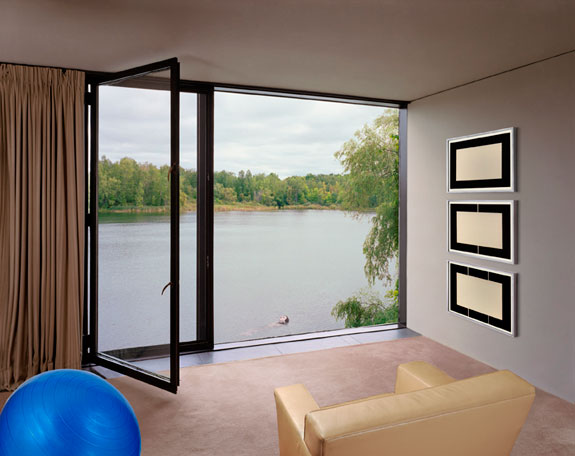
John Massey, a much exhibited and much admired Toronto artist, began his education in modernist culture when he was an eight-year-old. That was in 1958, when his family moved into the refined and elegant environment of an Ottawa house designed precisely in the manner of Ludwig Mies van der Rohe, the German-American prince of modernism. It was a new home, built in Rockcliffe Park on the shore of tiny McKay Lake by John's architect father, Hart Massey, the son of Vincent, who was then also in Ottawa serving as the first Canadian-born Governor General.
That same house makes a spectacular appearance this week in Phantoms of the Modern, John Massey's exhibition of manipulated digital photographs, which opened on Saturday at the new location of the Bailey Fine Arts gallery on College Street in Toronto. Massey's boyhood home provides the background for a series of large-scale prints that look at a glance like merely handsome photographs but turn out to be something far more interesting, a serious artist's 21st-century re-imagining of 20th-century modernism at its peak.
Unlike many imitators, Hart Massey knew how to reproduce the exquisitely proportioned spaces that were crucial to Miesian architecture. The Ottawa building in some ways resembles the Farnsworth House at Plano, Ill., which was completed eight years earlier and may be the closest Mies came to a perfect building. Unfortunately, its cost and its style displeased the client, Dr. Edith Farnsworth, who ended up hating her house, Mies, and for that matter modern architecture. Since Hart Massey was his own client no such conflict arose. When he died in 1996 that structure had become part of Ottawa history, the city's introduction to Bauhaus architecture.
John Massey grew up to be a sculptor, a filmmaker, a creator of installation art and one of many artists who have made photography central to their work. He's had solo exhibitions in Cologne, Paris, Antwerp, Pittsburgh and Long Island City, as well as Ottawa, Montreal and Toronto.
When the manipulation of photographs by computer became possible, it horrified people who saw it as a threat to the integrity of the picture. In 1982 the cover of National Geographic showed two pyramids digitally squeezed together to intensify the effect on the reader. That launched a thousand arguments over ethics, and to this day the Web site of the National Press Photographer's Association calls the National Geographic cover "a visual lie" that damaged a famous magazine's credibility.
Photographs don't lie, people used to say -- even though history contains many examples of photographic mendacity, the most famous being the Stalinist habit of excising from official pictures those colleagues who in losing Stalin's affection had also lost their lives. But 1980s computerization seemed far worse because it produced much more convincing images. In the privacy of their studios, photographers could create scenes that never existed while making them appear as convincing as "real" pictures.
Massey, far from being threatened by this new technique, was among those who enthusiastically embraced its possibilities as an artists' tool. He had already made many collage photo pieces laboriously constructed with the equivalent of paste and scissors. Now he saw a new era in photo art opening.
It helped confirm his long-held view that any kind of photograph amounts to an artificial construction rather than a simple depiction of reality. The photographer selects subject and viewpoint and crops the picture, then perhaps an editor selects the picture and crops it again. That's unquestionably manipulation, though it's the old-fashioned kind, accepted for generations by nearly everyone.
Massey was happy to use digital manipulation in many of his most ambitious works. Eventually he found a way to apply it to a subject that intensely interested him, modernist culture. He returned briefly to the place where he first encountered that culture and asked the current owners of his family's old home, Thomas and Susan d'Aquino, to let him occupy it alone for five days in the summer of 2003. He moved most of the furniture out of the way and took many, many digital photos.
His project was to re-imagine modernist design. Mies made buildings that were (or tried to be) as objective as machinery; Massey's work, on the other hand, contains a charge of personal feeling. Modernist architecture appears sexless; Massey's art usually contains subtle elements of sensuality.
Back in his studio in Toronto, he brought all of these forces together. He began digitally inserting into the photographs various works of roughly contemporaneous art, about three or four insertions a picture, all of which contrast with the perfection of the building. Into one picture he inserted sculptures by Giacometti and Maillol. Into another he placed a Michael Snow Walking Woman silhouette and an abstract painting by Ron Martin. To a third he added Brancusi's The Kiss and Stations of the Cross by Barnett Newman.
In every case he created absolutely convincing interiors, each of them a purely fictional room that has never existed except in a computer and now within a picture frame. So far as I know, it's impossible for the naked eye to see any difference between these pieces and "real" photos. Massey makes every insertion seem a natural part of the room.
Emerging on the gallery walls, the prints create little narratives, injecting a fresh sense of life into the modernist surroundings. And in each of them sexuality plays a role, "the slightly libidinous content," as Massey calls it, that he projected onto the house of his father. Sometimes it's clear, as in Snow's Walking Woman, and sometimes it's relatively hidden. He digitally pastes on the wall of one room a minimalist Donald Judd sculpture, which is not exactly sexy; but through the window we see a woman swimming in McKay Lake. On inquiry we learn this is no less than Hedy Lamarr, in a still photo digitally lifted from the 1933 Czech film Ecstasy, which depicted the first convincing orgasm in the history of cinema and earned her a Hollywood career.
Hart Massey, in building his Rockcliffe home, created an emblem in steel and glass of ideal modernist purity as Mies articulated it. Hart's son John, working in the relatively ephemeral and highly impure medium of digital photography, has created his own subtle, ambiguous monument to the building his father made and the era it expertly embodied.


